
Remote Work vs. Freelancing: What's the Real Deal?
People often use "remote work" and "freelancing" interchangeably, but they're actually quite different, even though both let you work from pretty much anywhere. Think of it this way:
• Remote Work is about where you do your job. You're still an employee of a company, just not in their office.
• Freelancing is about how you do your job. You're your own boss, working for multiple clients on a project-by-project basis.
Remote Work (aka "Work From Home" but Anywhere!)
When you're a remote worker, you're usually a full-time or part-time employee of a single company. You just don't commute to an office. You still have a boss, colleagues, and regular meetings (often virtual).
Pros of Remote Work:
• Steady Income: You get a regular paycheck, which is a big relief for most people.
• Benefits: Often includes health insurance, paid time off, retirement plans, etc. – things freelancers usually have to sort out themselves.
• Job Security: Generally more stable than freelancing. You're less likely to suddenly lose all your income streams overnight.
• Team Vibe: You're part of a team, which can be great for collaboration and feeling connected.
• Less Admin: The company can handle taxes, payroll, and other boring stuff (but it depends on the company and your home country regulations, you should always consider your personal taxes payments as your own responsibility).
• Career Growth: Clearer paths for promotion and professional development within the company.
Cons of Remote Work:
• Less Autonomy: You still have to follow company rules, schedules, and processes.
• Set Hours: Many remote jobs still expect you to work specific hours, even if it's from your couch.
• Company Culture: You might miss out on some of the in-person company culture and spontaneous interactions.
• Limited Variety: You're working on projects for one company, which might mean less diverse work if you like trying new things.
• "Always On" Feeling: It can be hard to switch off when your office is also your home.
Freelancing (aka "Be Your Own Boss!")
Freelancers are independent contractors. They don't work for a single company but instead take on projects from various clients. You're essentially running your own small business.
Pros of Freelancing:
• Ultimate Flexibility: You decide when, where, and how you work. Want to work at 3 AM? Go for it!
• Total Control: You choose your clients, your projects, and your rates. If you don't like a project, you can often say no.
• Income Potential: You set your own prices. The sky's the limit if you're good at what you do and can find enough clients.
• Variety: You get to work on a wide range of projects for different industries, keeping things fresh and exciting.
• Skill Development: Constantly learning new things to meet diverse client needs.
• Location Independence: Often even more flexible than remote work, as you're not tied to specific company time zones.
Cons of Freelancing:
• Unpredictable Income: Income can fluctuate wildly. Some months are great, others ... not so much.
• No Benefits: You're responsible for your own health insurance, retirement, paid time off, etc. This can be a huge expense.
• Client Hunt: You constantly need to find new clients and market yourself, which takes time and effort.
• Admin Overload: You handle all the business stuff: invoicing, taxes, contracts, marketing, accounting. It's a lot!
• Isolation: Can sometimes feel lonely without a steady team around you.
• No Job Security: If a client drops you, that's a chunk of your income gone instantly.
• Work-Life Balance Issues: It can be hard to switch off when your income directly depends on how much you work.
Which One to Choose?
The visual chart to summarize the above points is for you below.
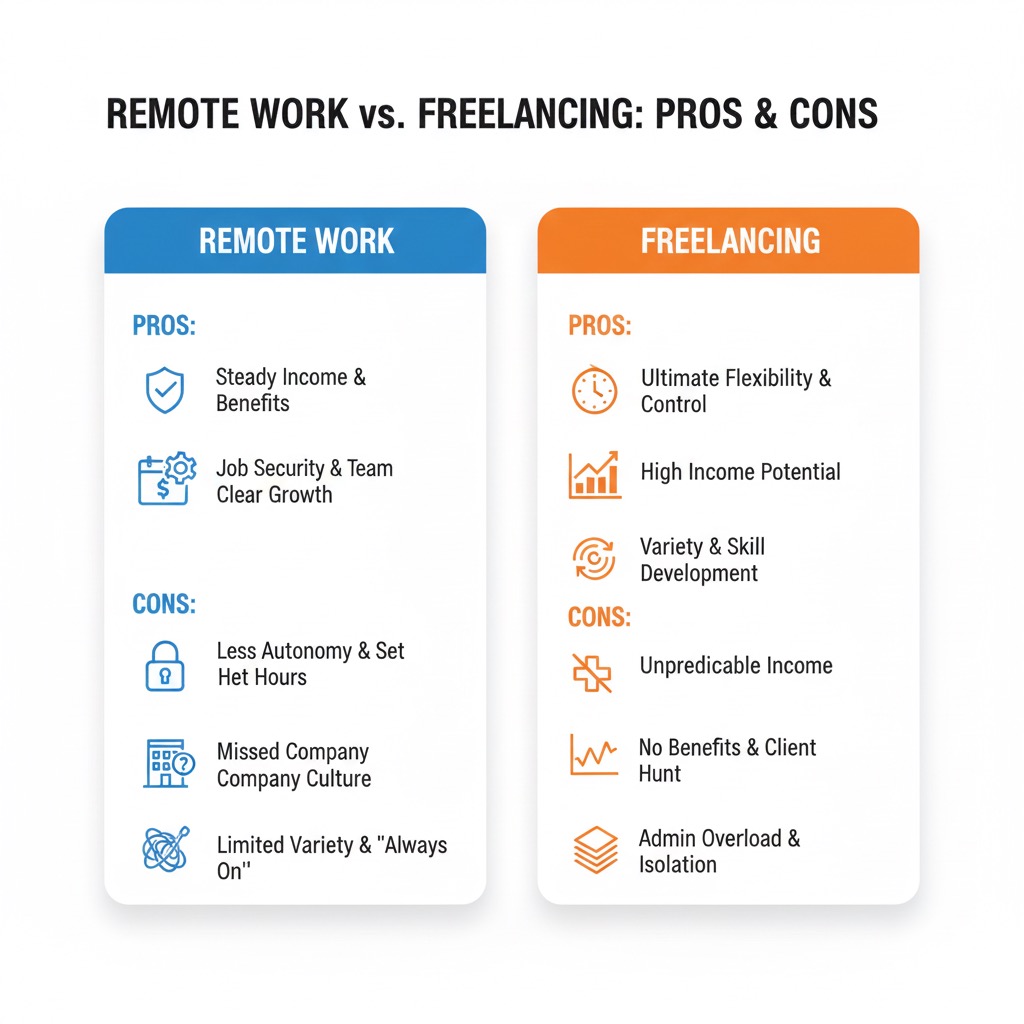
Choosing between remote work and freelancing really depends on your personality, priorities, and what you need from your career.
• Choose Remote Work if: You value stability, a steady paycheck, benefits, and being part of a team, but still want the flexibility of working from home (or anywhere).
• Choose Freelancing if: You crave maximum autonomy, control over your projects and schedule, enjoy variety, and are comfortable managing your own business and income fluctuations.
Both options offer incredible freedom compared to traditional office jobs, but they come with their own sets of challenges and rewards. Think about what truly motivates you and what kind of lifestyle you want to build!