What this guide covers
This guide covers the U.S. federal home-office deduction. It is general information, not individual tax advice or a complete list of business deductions.
Working remotely only tells you where you work. It does not determine whether you can claim a federal home-office deduction. Start with your worker and tax status, then consider how you use the space.
State and local taxes, cross-border work, expense reimbursements, and worker-classification disputes are separate questions. Narrow federal rules may also affect certain employee expenses without creating a general home-office deduction for employees. Check current guidance for the jurisdiction and filing year involved, or ask a qualified tax professional.
First identify your worker status
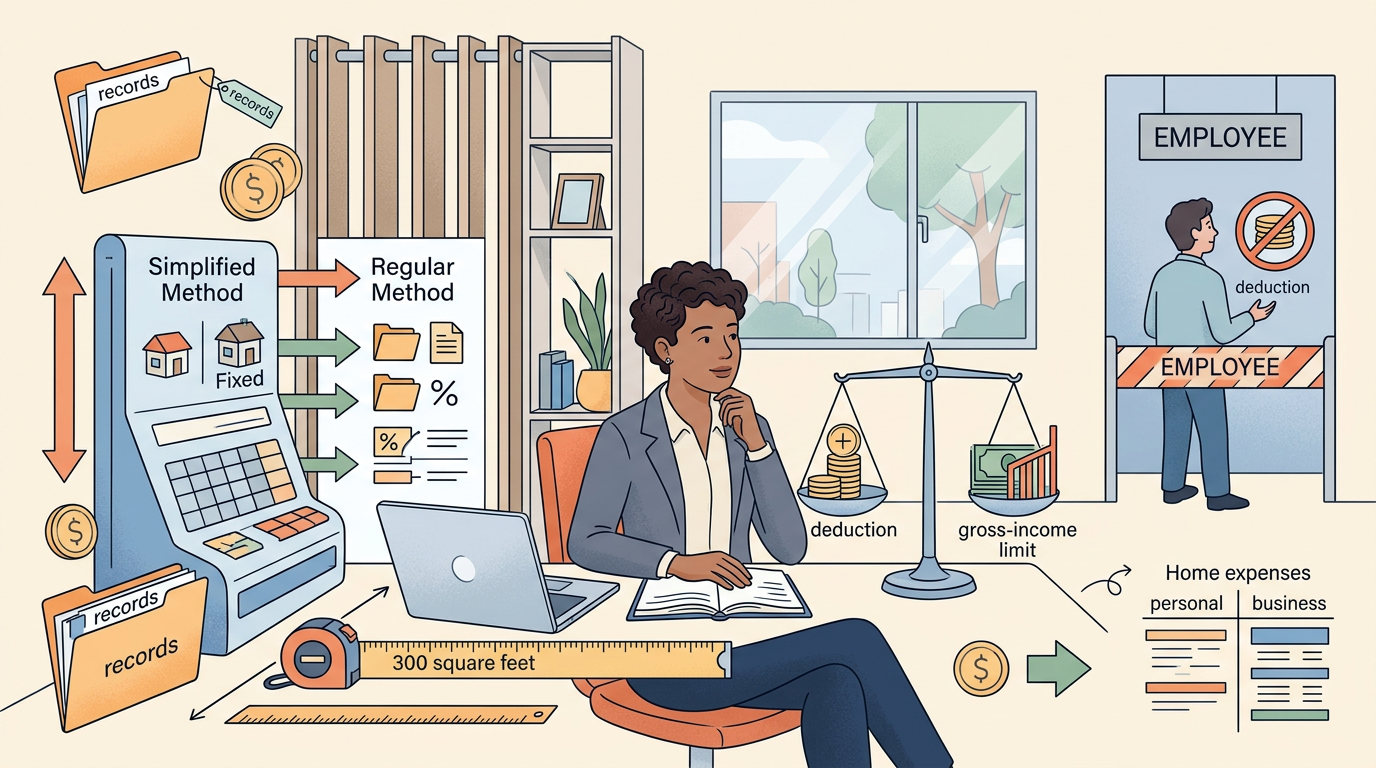
Employees: Employees cannot claim the federal home-office deduction, including through the simplified method. The IRS simplified-option guidance explains that miscellaneous itemized deductions for employee business expenses were eliminated for tax years beginning after 2017.
Self-employed workers and partners: You may qualify for expenses related to business use of your home, but remote work alone is not enough. A 1099 form, contractor label, or remote job title does not prove that every federal tax requirement is met. Partners may also qualify in some circumstances, but partnership arrangements require current, situation-specific guidance.
If you are reviewing a remote offer, clarify these points before assuming a deduction is available:
- Who engages you and who pays you?
- Is the arrangement employment or an independent business?
- Is there a written policy for reimbursing work expenses?
When a Remoote listing provides an employer name or employment type, use those details to frame your questions. Confirm the actual arrangement and reimbursement policy in writing. A listing field does not decide your federal tax status.
Test the workspace
The IRS business-use-of-home rules generally require a self-employed person to use part of the home both exclusively and regularly for business.
- Exclusive use generally means the defined area is used only for the business, not for a mix of work and personal activities.
- Regular use means recurring business use, not occasional or incidental work at home.
You must also meet a qualifying business-use test. One common route is using the home as your principal place of business. At a high level, a home workspace can satisfy this test when you use it exclusively and regularly for administrative or management work and have no other fixed location where you conduct substantial administrative or management activities.
Storage, rental, and daycare uses have limited IRS exceptions. They are not general exceptions for remote workers, so consult the specific rules before relying on one.
For example, working every weekday at a kitchen table that is also used for meals may fail the exclusive-use test even though the work is regular. A dedicated area used only for the business presents different facts. This example illustrates the test rather than deciding any reader's eligibility.
Compare the methods and income limit
After establishing that the workspace qualifies, an eligible filer can compare the simplified and regular methods.
Simplified method
The IRS simplified option uses $5 per square foot of qualifying business space, up to 300 square feet. That produces a maximum calculation of $1,500 before the applicable gross-income limitation. It does not guarantee a $1,500 deduction.
Regular method
The regular method allocates actual home expenses between business and personal use. It requires supporting records and can include depreciation for the business portion of the home.
The limit both methods share
Under either method, the allowed home-office deduction can be lower than the initial calculation, or zero, after the applicable gross-income limitation. The result depends on business income and other business expenses, so this guide cannot calculate an individual deduction.
An amount disallowed under the simplified method cannot be carried forward. Under the regular method, an excess amount may be carried forward, subject to the following year's limitation.
The simplified method uses a prescribed calculation, while the regular method requires expense allocation, more supporting records, and attention to depreciation. Those are administrative and tax tradeoffs, not a reason to recommend one method or estimate personal savings without the filer's full facts.
Keep other business expenses separate
The home-office deduction is one category. Failing the home-office test does not by itself decide whether a self-employed person has other deductible business expenses. Qualifying for a home office also does not make every work-related purchase deductible.
The IRS Schedule C instructions treat business expenses unrelated to qualified business use of the home separately in Part II. IRS examples include advertising, wages, supplies, and depreciation of equipment or furniture.
Each separate expense has its own federal eligibility, substantiation, and business-versus-personal allocation rules. These examples are not a generic list of remote-worker deductions. Employee expense treatment is also different from the treatment available to a self-employed Schedule C filer.
Keep records and use current instructions
A potentially qualifying self-employed reader should keep records that support both the eligibility decision and any amount reported, including:
- the business arrangement and who engages and pays the worker;
- measurements of the area used for business;
- the dates and nature of business use;
- business gross-income and expense records; and
- supporting home-expense records when using the regular method.
Use this decision path:
- Identify your federal worker and tax status.
- Test whether the space meets the applicable business-use rules.
- Review the gross-income limitation using your business income and expense records.
- Compare methods only if you are eligible.
- Use current IRS instructions for the filing year or seek individual advice before claiming the deduction.
Pause for professional help if you have both employee and business income, work through a partnership, cross borders, use shared space, or need to resolve state-tax questions.