Check eligibility before rebuilding your portfolio
A detailed description can make an opening feel like a close match: you know the methods, understand the product and have a study worth discussing. But if the employer cannot engage you in your country, improving the presentation will not resolve that constraint. Check eligibility first, then invest in tailoring your evidence.
Separate five questions that the word remote does not answer:
- Hiring location: Which countries or regions does this opening cover?
- Your situation: Does the employer support your actual country of residence and any required work authorization?
- Team hours: What regular overlap is expected, in which time zone?
- Participant sessions: When would interviews or usability sessions happen? These hours may differ from team meetings.
- Travel: Are in-person events required, and what arrangements, costs or accommodations apply?
For example, Canonical's Senior Design Researcher, User Science description, reviewed on 14 October 2026, said “Home based” in EMEA: Europe, the Middle East and Africa. Its application also asked about attending two to four international company events each year, lasting one to two weeks. The form said travel-related disability accommodations could be discussed. Neither a regional label nor a worldwide location dropdown confirms that every country or individual is eligible.
A concise clarification question is: “Can you engage someone resident in [country] for this role, and what team overlap, participant-session hours and travel arrangements would apply?” This is a question to the employer, not a substitute for immigration, payroll or tax advice.
Check that the employer still accepts applications through its current careers route. A third-party description can remain after closure. The first page of a third-party researcher vacancy collection inspected on 14 October 2026 mixed location-specific remote labels with entries explicitly marked expired. Treat such listings as leads, not confirmation of availability or eligibility.
- Apply: The opening is accepting applications, your location and practical constraints fit, and your experience supports the stated responsibilities.
- Clarify: A material condition is missing or contradictory, such as country coverage, live-session hours or what work the role owns.
- Skip: A confirmed requirement rules the opening out, such as an unsupported residence location or essential duties you cannot undertake.
A missing fact belongs in the clarify category. A preferred skill is not automatically a disqualifying requirement.
Read the responsibilities, not just the title
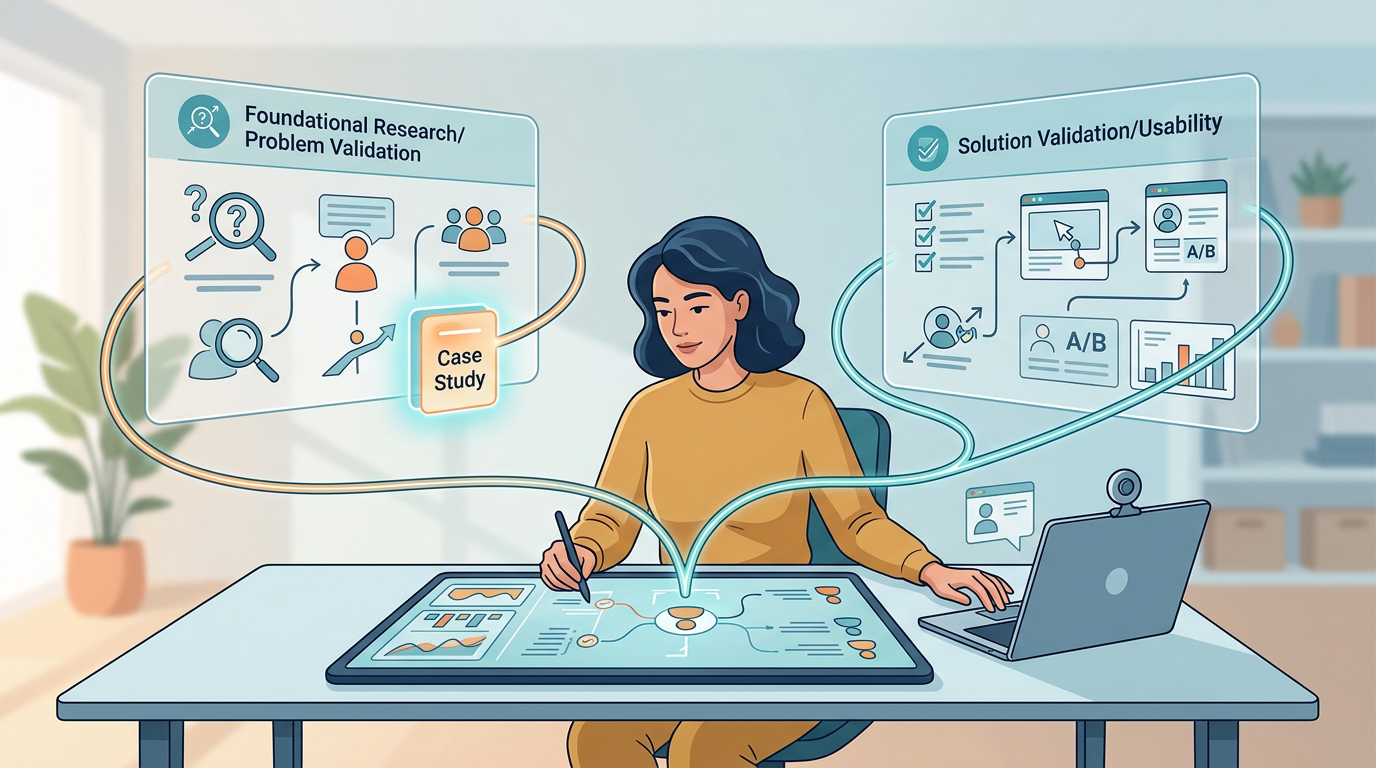
Two research openings can need different evidence. Problem-validation or foundational research asks what people need, what problems they encounter and which opportunities merit attention. Solution validation tests a proposed experience: whether people can use it, understand it or complete a task. These distinctions help you read a role; they are not a universal division of labor.
The employer examples below reflect material reviewed on 14 October 2026. They illustrate differences in scope, not a claim that all these roles are currently open.
| Role or reference | Work described | Relevant case-study evidence | What remains to clarify |
|---|---|---|---|
| GitLab UX Researcher role library | Planning, conducting, analyzing and reporting research using qualitative and quantitative methods. It mentions remote research and enterprise or developer-tool experience. Its hiring guidance prefers problem-validation, foundational or strategic studies because Product Designers conduct solution validation. | A needs or problem question; relevant users and domain; method and recruitment rationale; synthesis; and how findings informed prioritization or strategy. Show your ownership and collaboration. | This is a role/process reference, not a vacancy or worldwide hiring promise. Confirm the actual opening's location and level. Intermediate scope includes manager-supported prioritization and deliverables; senior and staff scope adds broader programs, mentoring, synthesis and organizational influence. |
| Canonical Senior Design Researcher | User research, concise findings, integration into product and engineering decisions, research-operations infrastructure and training. It requests qualitative and quantitative proficiency, with exceptional depth in either area. | A study connecting evidence to product, strategy or organizational change. Identify the research you led, stakeholders you worked with and any operations or training you actually owned. | Confirm country eligibility, resources and scope. The inspected form also contained web-design questions; clarify a material mismatch rather than assuming those questions are irrelevant. |
| Canonical Usability Engineer | Synthesis of A/B-test and usability-study data, lightweight prototypes, dashboards or scripts, audience-sensitive communication and research scalability. | Analysis or prototyping work showing exploration, optimization and action, with the reasoning behind changes and communication to the people who could use the findings. | An adjacent title is a search lead, not automatic equivalence to a UX researcher role. Confirm the balance of research, analysis, engineering and tooling. |
For each opening, make a short note of the decision or research question, users and domain, methods, recruitment and session logistics, independent ownership, stakeholders, and output and intended use. Write “not stated” where the description leaves a gap. Do not fill it with assumptions drawn from the title.
Then compare those notes with your actual contribution. Participating in research, moderating interviews, leading a study, designing the product and owning research operations are different responsibilities. If you moderated sessions while someone else set the question and synthesized findings, that is useful evidence of moderation, not proof that you led the whole study.
Read credentials with the same care. Canonical's inspected senior researcher description allowed a related degree or a compelling account of an alternative path. Its adjacent usability description listed Linux, certain infrastructure concepts and named analysis frameworks as nice-to-have items. Those are employer-specific distinctions, not a universal degree, certification or tool checklist.
Choose a study that proves the work
The study you are proudest of may not be the one that best supports this application. A polished usability project can demonstrate careful testing while leaving unanswered whether you can investigate an uncertain problem before a solution exists. For GitLab's published preference, that gap matters. For Canonical's Usability Engineer scope, analysis and prototyping may be more directly relevant. Neither comparison guarantees acceptance or rejection.
Hypothetical comparison: imagine you have two authorized work samples:
- A developer-workflow discovery study. You investigated where users struggled, selected participants, analyzed interviews and proposed which problems the team should investigate next. This could support a foundational-research application, particularly in a developer-tool context. You would still need to show the recruitment criteria, synthesis, your individual responsibility and whether anyone acted on the recommendations. It would not by itself prove quantitative analysis or research-tooling skills.
- A checkout usability and prototyping study. You examined task failures in an existing flow and explored changes through lightweight prototypes. This could support a usability-focused role. You would still need to explain the method, participants, analysis and decisions. It would not establish A/B-test experience unless that work actually occurred, nor answer GitLab's preference for foundational or strategic research on its own.
These are invented examples, not reported applicant histories or business results. The point is to choose by user population, research question, methods, complexity, personal contribution and decision influenced, rather than visual polish or the number of tools used.
Academic, volunteer and independent studies can demonstrate reasoning. Label their context, supervision and limits clearly. An independent practice project does not become client work because it uses a real company's product. It also does not satisfy a stated professional-experience requirement or prove a business outcome that never occurred.
Nikki Anderson's Dscout case-study guide recommends selecting projects against the job profile and not inventing information to fill topics the project did not cover. The User Interviews portfolio guide likewise emphasizes research evidence rather than polished final-design visuals. These are practitioner and vendor guidance, not universal hiring rules.
Explain the chain from question to decision
A useful case study lets someone follow your reasoning. They should be able to see why you asked the question, why the evidence was appropriate and what it did or did not justify. Use this worksheet to prepare the study, then adapt its order and depth to the employer's instructions. It is not a requirement to build a new website or use a paid portfolio platform.
- Context and question: What situation prompted the research? What decision was it meant to inform, and who needed that decision?
- Your responsibility: What did you personally plan, conduct, analyze or communicate? Name collaborators' contributions separately.
- Constraints and method: What time, access, budget or technical limits applied? Why did you choose this method? Which alternatives did you reject, and why?
- Participants and recruitment: Who qualified, how were they recruited and what was the actual sample size? Which relevant groups or experiences were missing?
- Sessions or data collection: Which moderation questions, tasks or measures addressed the research question? Explain consequential changes to the plan.
- Analysis and synthesis: How did you move from notes or data to patterns? How did you handle conflicting evidence and alternative explanations?
- Findings and limits: What did you observe, what did you infer, and what remained unresolved? Explain why a small or narrowly recruited sample cannot establish what all users experience.
- Recommendations and decisions: What did you recommend? What did the decision owner actually choose? Keep those separate.
- Outcomes and reflection: What effects were documented or measured? If implementation or business effects are unknown, say so. What would you change in a future study?
Make the distinction between evidence and advice visible. For example, an observation might be that participants hesitated at a particular control. Your interpretation concerns why they hesitated; your recommendation concerns what to investigate or change. Alternative explanations can remain plausible even when the observation is clear.
Choose a small number of authorized artifacts that explain a consequential choice: a redacted screener showing recruitment logic, a discussion-guide excerpt linking questions to the research objective, a synthesis excerpt or a decision record. Explain what each artifact demonstrates. An unexplained wall of notes adds volume without making your reasoning easier to assess.
Keep claims about impact proportionate. A recommendation is not an implemented change. An implemented change is not a measured improvement. Even when an improvement was measured, attributing all of it to one study requires support. A documented decision influenced by your findings is worth explaining without adding a revenue claim you cannot substantiate.
Make the evidence safe to share
Confidential work creates a real constraint: you may have the relevant experience but lack permission to show the original material. Do not treat that as a reason to disclose it quietly. Apply two separate gates:
- Employer or client permission: Are you authorized to disclose the work, including proprietary information, internal decisions and project details?
- Participant information: Is this use and sharing consistent with the consent, intended purpose and applicable data-handling arrangements?
Passing one gate does not pass the other. A participant's consent does not authorize disclosure of client intellectual property. An employer's approval does not make unrestricted participant disclosure appropriate.
GOV.UK consent guidance explains that participants should understand the purpose, collected data, intended use and sharing, recording, retention and withdrawal arrangements. Its research-data guidance recommends approved storage, restricted access and fully anonymized extracts where possible, and advises against publicly sharing non-anonymized outputs. These are responsible-research principles from UK government guidance, not personalized legal advice for every country.
Names are not the only identifiers. Job titles, locations, distinctive stories, screen content or combinations of details can reveal someone. Blurring a name, adding a password or using an unlisted video link does not itself authorize external disclosure.
If authorization is absent, seek approval for a high-level account of methods and decisions that excludes restricted details. If that is not possible, choose another authorized study or use a clearly labelled fictional substitute to demonstrate your approach. Fictional material must not be presented as evidence of real participants, findings or outcomes.
Do not upload raw recordings, transcripts, screeners, consent forms or proprietary data into a portfolio or personal AI service. Use only material you are permitted to share through the intended channel.
If you conduct a new study, make participation voluntary, provide understandable information about the purpose and data use, obtain appropriate recording consent and establish secure storage and access arrangements before collecting data. A portfolio exercise does not remove those responsibilities.
Follow the actual interview instructions
An initial portfolio submission, a scenario discussion, a recorded walkthrough and a live case-study presentation are different tasks. Check which one the employer requests rather than preparing the same slide deck for all four.
GitLab's published process, reviewed on 14 October 2026, described a scenario-based interview followed by a recorded case-study walkthrough of up to 20 minutes, returned within ten days. Elsewhere the page used slightly different deadline wording, so confirm the actual deadline with the recruiter. Its requested content included research questions, personal contribution, method rationale, synthesis, outputs, challenges, confidentiality-respecting findings and impact. This is one employer's process, not a general duration rule or permission to put confidential work on a video service.
Prepare to explain choices under changed conditions: what you would do if recruitment failed, time shortened, evidence conflicted or stakeholders disagreed. Consider alternative methods and the limits of your synthesis. These are useful preparation areas, not reported interview questions.
Follow the stated duration, file format, sharing channel and accommodation process. Test that the intended reviewer can access the presentation without opening it to a wider audience. For a live presentation, test the video-call setup and screen sharing, and leave room for questions within the agreed schedule. No fixed slide count is needed.
Canonical's application rule is particularly important: the inspected form required applicants to use their own words and said plagiarism or AI-generated application content would disqualify an application. Use this article to organize your thinking about real experience, not as answers to paste into that application. Write your own account and follow the employer's permitted-tool rules.
For a new take-home task, clarify scope, expected effort, permitted tools, compensation, confidentiality and whether the output is a simulation or intended for live use before doing substantial work. Do not assume a task's research data or resulting work can later go in your portfolio.
Carry the fit check into the work
The application shows what you can do. An offer also needs to establish the conditions under which you would do it. Ask about currency, gross pay, pay period, employee or contractor status, fixed-term conditions, benefits, expected hours, participant-session timing and travel costs. Canonical's inspected researcher page said base pay depended on location, experience, knowledge and skills, but disclosed no numerical base-pay range. That does not support a salary benchmark for you or for remote researchers generally.
Before accepting research ownership, ask what makes the work feasible:
- Which participants can you access, and who supports recruitment?
- What budget covers recruitment, incentives and the research itself?
- Which tool licences and approved recording or transcription systems are supplied?
- What data can you access, and what permissions govern collection and sharing?
- Who reviews the work, supports difficult decisions and can act on recommendations?
These are practical questions, not assumed industry defaults. Responsibility without participant access or a decision owner is a material fit issue. Requests to pay for access to a job, an unclear employer, vague work or pay, or premature requests for sensitive documents also warrant verification before you proceed.
For the first agreed study, confirm the question, intended decision, participant criteria, timeline, consent and data arrangements, and the person who owns the decision. That connects the responsibilities discussed in the application to the work you can actually deliver.
Start with Remoote's UX Researcher title search and inspect an individual description against your country and research experience. Matching results, current application availability and country coverage are not guaranteed. For the first apparently compatible opening, identify its most important unanswered requirement and ask about it before tailoring your case study.