Match the role to evidence
You may have handled difficult customers, written clear tickets, and learned Linux or networking, yet still find yourself staring at an application question about debugging. The missing piece is not necessarily another certificate. It may be a concrete example that connects your technical decisions to a customer's problem.
A short support case can help you prepare that explanation. It is optional unless the employer requests one, and it does not replace required experience. Choose a suitable vacancy first: a careful API exercise will not demonstrate Windows Server administration, and a helpdesk ticket will not automatically establish developer-product support skills.
These employer examples come from pages captured on 9 October 2026. They illustrate different kinds of work, not a promise that the openings remain available:
- GitLab's support job family distinguishes customer support representatives, associates developing technical debugging skills, and support engineers managing cases through triage, reproduction, engineering handoff, and resolution. Its AMER Support Engineer posting names Linux administration, scripting and MVC familiarity, Git and CI/CD, and technical customer communication.
- Support Adventure's IT-support technician page emphasizes Windows desktop and network troubleshooting, Microsoft 365, Windows Server, virtual-device administration, ticket documentation, and explaining problems to nontechnical users. That is a different evidence target from developer-product support.
- Canonical's Associate Linux Support Engineer page asks for Linux troubleshooting, customer communication, and hands-on knowledge in multiple technical areas. Associate does not mean no technical experience. The page also asks for academic evidence or an alternative-path narrative.
For your chosen vacancy, turn a few core duties into evidence you can discuss. These are preparation suggestions, not employer-mandated submissions:
| Advertised work | Possible evidence |
|---|---|
| Linux or log investigation | A relevant lab or permitted work example showing the symptom, selected log evidence, and why you chose the next check. |
| Support writing | A customer update that explains impact, progress, uncertainty, and the next action without dumping internal detail. |
| Reproduction and escalation | A handoff with environment, repeatable steps, expected and actual results, and a specific request for help. |
| Case ownership | A record of the corrective action, verification of the original operation, and the closure or follow-up decision. |
Beside each requirement, mark your evidence as professional work, self-directed lab, study only, or not yet demonstrated. Do not let those categories blur. Reading about token authentication is not the same as investigating it, and a lab is not production incident ownership.
Apply when you can evidence the core work and meet the stated conditions. Prepare when a specific, bounded gap can be practiced honestly. Choose a different role or level when the core responsibility is still beyond what you can demonstrate. There is no universal years-of-experience or certification threshold here; use the actual posting. GitLab's example also welcomes varying experience rather than insisting every applicant satisfy every item.
Check eligibility before investing
If you live outside the United States, resolve location fit before spending days on a tailored case. GitLab's AMER posting names Canada and the United States. AMER does not make that vacancy available throughout the Americas.
Record what the posting confirms, then send the recruiter the questions it leaves open:
- Can the employer hire someone in your current country of residence? What work authorization is required, and is sponsorship available if needed?
- Is the arrangement employee or contractor, and what location-specific pay and contract terms apply? GitLab's published base-salary range in this example is for US residents; it cannot price the role in Canada or elsewhere.
- Which working hours, customer languages, and channels are required? What weekday, weekend, or on-call coverage would you actually provide?
- Is travel required, and can you meet the confirmed obligation?
Remote culture does not remove scheduling requirements. GitLab's example includes weekday and weekend daytime on-call rotations. Canonical labels its associate role globally remote but still lists technical prerequisites, a background check, and weekend rotation. That label alone does not establish hiring feasibility in every country.
Canonical's travel wording also needs clarification: the role text mentions international travel twice yearly for events up to two weeks, while the application asks for commitment to two to four annual events lasting one to two weeks. Ask which obligation applies rather than treating it as travel-free work from anywhere.
Build one practice support case
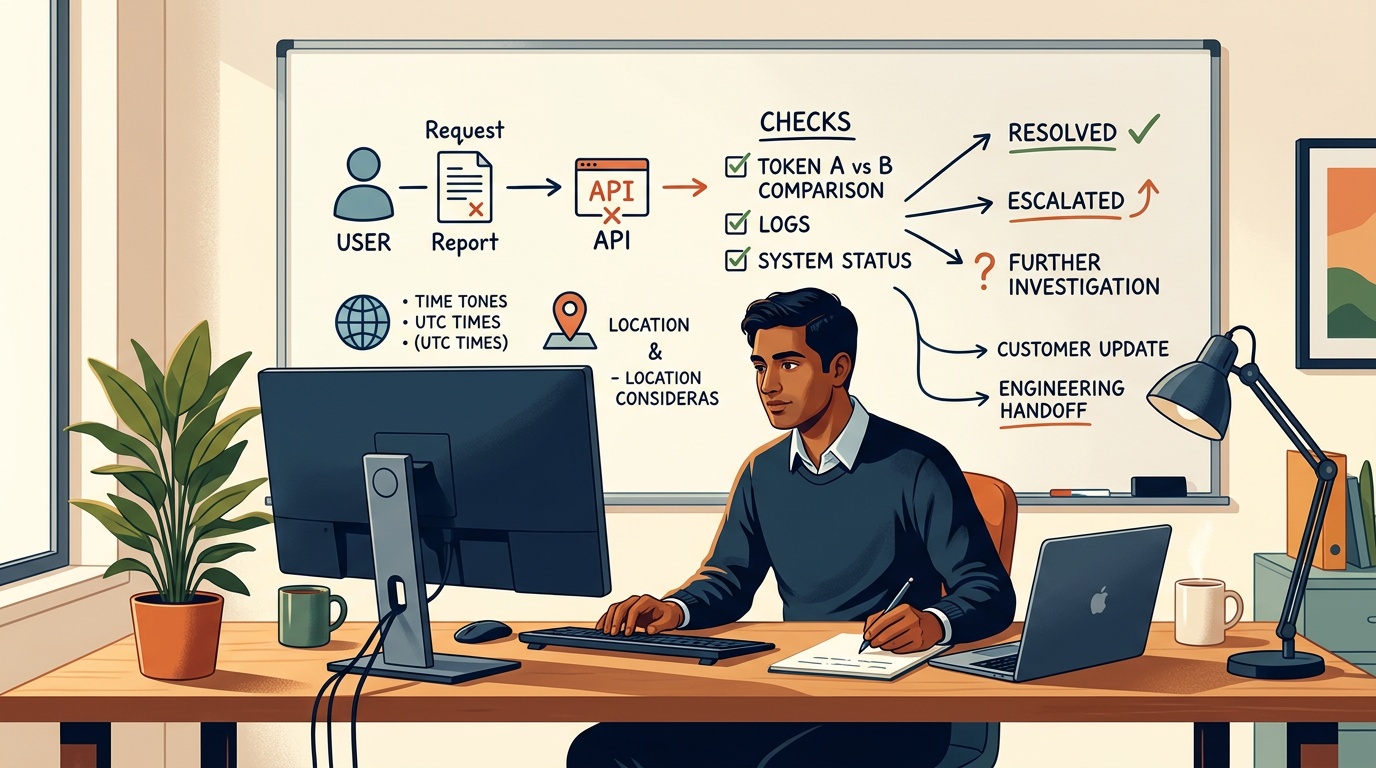
A customer says, “The report stopped loading.” It is tempting to name a familiar cause immediately: the token expired. A useful case shows why you resisted that shortcut, what you checked, and how far the result lets you go.
The following record is entirely fictional. It is a learning example in an authorized sandbox, not a real customer incident or an experiment we ran. The client, API, observations, and times are invented. To build your own case, perform your own authorized checks and record their actual results. Do not claim these results as yours.
Scope and questions
In the simulation, one dummy account cannot retrieve its demo report through a practice client. The immediate impact is that this account's report retrieval is blocked. Other accounts and workflows have not been tested.
Before changing anything, the investigator asks: What exact operation fails? When did it last work? What response does the client receive? Did the client configuration or credential change? Does the same failure occur on retry? Who can authorize a credential change? Ask for sanitized evidence through an approved channel, not for someone to paste a token into a ticket.
The fictional record fixes the following conditions:
- Environment: isolated practice sandbox; Practice Client 1.0.0; Demo Reports API v1.
- Account and permissions: dummy account
practice-reader, authorized to read demo reports withreports:read. Account permissions do not change during the comparison. - Request:
GET https://api.example.test/v1/reports/demo-001, no query parameters and no request body;Accept: application/json; documented OAuth bearer-token authentication. - Expected response: HTTP
200with{"id":"demo-001","status":"ready"}, displayed by the client as the ready demo report. - Credential labels: A is the originally configured dummy token; B is an authorized valid dummy token for the same account and intended access. Only labels appear in the record, never token values.
- Controls: endpoint, client/API versions, account, permissions, method, headers other than the credential, and body remain unchanged. Requests occur at the recorded times; no other sandbox configuration changes are made between them.
The controlled comparison
The first response is an authentication failure. MDN explains HTTP 401 as a request lacking valid authentication credentials, unlike 403, where valid credentials lack permission. Neither status alone supplies a complete diagnosis.
In this OAuth bearer-token example, the response also includes invalid_token. RFC 6750 section 3.1 says that error can cover expired, revoked, malformed, or otherwise invalid tokens. It does not mean “expired” specifically. Those references explain the response semantics, not the invented observations below.
| Fictional time, UTC | Check | Sanitized result |
|---|---|---|
| 8 October 2026, 09:00 | Perform the report request with A. | HTTP 401; WWW-Authenticate: Bearer error="invalid_token"; response body {"error":"invalid_token"}. The ready report is absent. |
| 09:05 | Repeat the otherwise identical request with B, using the sandbox's approved credential-change procedure. | HTTP 200; body {"id":"demo-001","status":"ready"}. |
| 09:07 | Repeat the original report operation through Practice Client 1.0.0, now configured with B. | HTTP 200 with the expected body; the client displays the ready demo report. |
The sanitized evidence record contains the request shape, version information, timestamps, status codes, response bodies, and authentication challenge above. The authorization value is omitted. In a real case, attach only evidence you are authorized to retain and share.
The competing explanations include a missing or malformed credential, expiry, revocation, or another token-specific validity problem. The comparison shows that changing the token changed the result in the tested conditions. The client verification shows that the original report operation was restored, not merely that a separate request succeeded.
Cause: undetermined. Withdraw “token A expired” as a diagnosis. Expiry remains a possibility, alongside revocation, malformed token content, and other token-specific problems. B succeeding does not establish why A was rejected.
Keep three conclusions separate:
- Operation restored: yes, for the tested report operation in this simulation.
- Underlying cause established: no.
- Recurrence prevented: not established.
Using the authorized valid test token is a bounded corrective action here. It is not evidence for broad resets, permission changes, or longer token lifetimes. Do not make those changes without a supported reason and authority.
If the replacement does not work
This is a separate alternative, not a later event in the successful timeline. Suppose the B request also returns 401, or returns 200 without the expected report payload. The replacement has not restored the operation.
Record the actual status, headers, body, and client behavior. Mark the working hypothesis “an authorized replacement token will restore this request” as unsupported by that check. Next evidence might include the documented authentication scheme, the intended token audience and scope, issuer status, or authorized sanitized server-side validation information. Obtain it through the approved process without exposing credentials.
A failed request is not proof of a product bug. Even another invalid_token response does not identify expiry.
Use the record, not its invented results
For your own completed case, keep a compact checklist:
- The user's symptom, affected operation, and known impact.
- The clarifying questions and answers, including authority to investigate or change anything.
- The environment, versions, request or reproduction steps, permissions, and expected result.
- The competing explanations and the check chosen to distinguish them.
- The actual observations, timestamps, sanitized evidence, and unsuccessful attempts.
- The authorized corrective action, or the unresolved state and next evidence needed.
- Verification of the original operation, the limits of that verification, and the closure or escalation decision.
A concise annotated document is enough for this preparation task. It does not require a public repository, paid cloud account, or portfolio website. This API example can demonstrate investigative method and communication; it cannot establish production incident ownership, the full Linux or Microsoft stack, or competence with technology you have not used.
Write for two different recipients
The customer needs to know what they can do now and what remains uncertain. An engineer needs enough detail to investigate without reconstructing the case. Writing both helps expose gaps that a polished technical summary can hide.
Customer update
Fictional update for the successful branch, sent at 09:15 UTC:
The API rejected the original token. With an authorized valid test token, the report request now succeeds, and we have confirmed that the practice client displays the expected report. We have not confirmed why the original token was rejected.
The tested report operation is restored; other workflows have not been checked. Please use only the credential configured through the approved sandbox procedure. If the failure returns, send the time and sanitized error through the approved support channel, without including the token.
While we check whether further investigation is needed, I will update you by 10:00 UTC, even if the cause is still unconfirmed.
That final line commits to an update, not a fix. Use a cadence permitted by the target team's instructions. A service-level agreement, or SLA, defines the employer's response or resolution commitments; it is not permission to invent a fix date.
Engineering handoff
Engineering escalation is not automatically necessary because the rejection reason is unknown. Support may close the restored operation under its approved process, documenting the unknown cause. Remaining impact, recurrence, or a required security/escalation process can change that decision.
If further investigation is warranted, this fictional main-branch handoff carries the same evidence:
Impact and state: Report retrieval was blocked for dummy account practice-reader. The tested operation is now restored with B. Other workflows and accounts are untested; cause and recurrence prevention remain unconfirmed.
Environment and reproduction: Practice Client 1.0.0, Demo Reports API v1, isolated sandbox. Account permission: reports:read. GET https://api.example.test/v1/reports/demo-001, no query or body, Accept: application/json, OAuth bearer authentication. Expected: 200 and {"id":"demo-001","status":"ready"}.
Observed checks: At 09:00 UTC on 8 October 2026, A returned 401 with a Bearer invalid_token challenge and {"error":"invalid_token"}. At 09:05, the otherwise identical B request returned the expected 200 and body. At 09:07, the original client operation with B displayed the ready report. Only the credential changed; versions, account permissions, endpoint, and request shape were held constant.
Evidence and limits: Sanitized request/response records accompany the case; credential values are excluded. The token change restored this operation. Expiry, revocation, malformed content, and other validity problems have not been distinguished.
Help requested: If approved validation information is available, please determine why A was rejected and whether follow-up is required. We are not reporting a proven expiry or product defect.
For the separate unresolved branch, retain the environment and reproduction details but replace the successful results with your actual failed B check. The conditional handoff request becomes: “The expected authenticated report operation still fails with B. Please help identify why, using approved authentication-validation evidence. The replacement-token hypothesis did not restore the operation; no product defect or expiry has been established.” State the remaining customer impact and the next-update time under the team's process.
Mozilla's bug-writing guidance provides useful reporting principles: precise reproduction, environment, expected versus actual results, and facts separated from speculation. Adapt those principles for the receiving team. Do not submit fabricated practice bugs to public projects.
Never publish former employers' customer tickets, credentials, personal data, private hostnames, or internal screenshots. Superficial redaction does not grant permission to share a work example. Authorization and confidentiality still govern it. Dummy lab material is usually the simpler preparation choice when sharing rights are unclear.
Explain your own work
Use the example to learn, not as application text to paste. Canonical's captured application explicitly requires candidates' own words and says plagiarism or AI/other generated content will disqualify an application. Follow each employer's current originality and assessment rules. Do the work and write your own answers; do not use this sample to evade those rules.
When you have genuinely completed a lab, label it as a self-directed project. In your own words, describe the problem you reproduced, the check you selected, the observed result, and the limitation. Keep it under projects rather than presenting it as customer-facing employment.
If you have a relevant professional example, select one you are permitted to discuss and distinguish your contribution from the team's. Any outcome numbers must come from your real records. Do not add a percentage improvement to make an otherwise useful case sound stronger.
Prepare to explain the case aloud, without reading it as a script:
- What did you know at the start, and what were you only suspecting?
- Why did you choose that check instead of changing several things at once?
- Which hypothesis failed, or which diagnosis did you withdraw?
- What did you tell the customer, and what detail belonged only in the handoff?
- How did you verify the original operation, and what remained untested?
Support Adventure's stated process includes a technical assessment, then required candidate videos and further testing for selected candidates. That is one employer's process, not an industry-wide sequence. It illustrates why both written and spoken explanation matter.
Confirm the actual exercise format, permitted tools, time limit, and any accommodation needs before starting. Your case is preparation, not a substitute for an employer's test or a document every recruiter will read.
Check the work behind the offer
Before accepting, ask about the actual support stack and customer channels, who owns escalation, response commitments, shift and weekend coverage, training, travel, and location-specific pay and contract terms. The GitLab rotations and Canonical travel wording show why “remote” is not a complete description of the working arrangement.
Pause if the employer's identity is unclear, you are asked to pay for training, equipment, or access to work, sensitive documents are requested without an explanation, or an assessment requires unauthorized access to real systems. Clarify through a verified employer channel before proceeding.
During onboarding, learn the team's approved evidence-handling and escalation procedures. A practice workflow does not authorize access to customer systems or changes to production settings. If applications do not progress, revisit role level, country eligibility, and the technical proof you are missing rather than assuming another case guarantees interviews.
For your next comparison, use Remoote's Online Chat and Technical Support Jobs page to look for suitable technical-support and support-engineer listings. It is a broad pool mixing support roles and countries, not an engineer-only or worldwide-eligible list. Read each full description and confirm the employer's current requirements; vacancies change. If helpful, use the displayed Set alerts offer for daily matching-job emails, then apply the same role, location, and schedule checks to each match.